
Log in
en
English
Русский
Español
Dansk
Türkçe
Bahasa Indonesia
Svenska
Deutsch
Nederlands
Українська
Português
Srpski i Crnogorski
Български
Magyar
Hrvatski
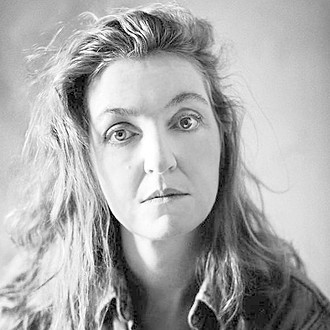
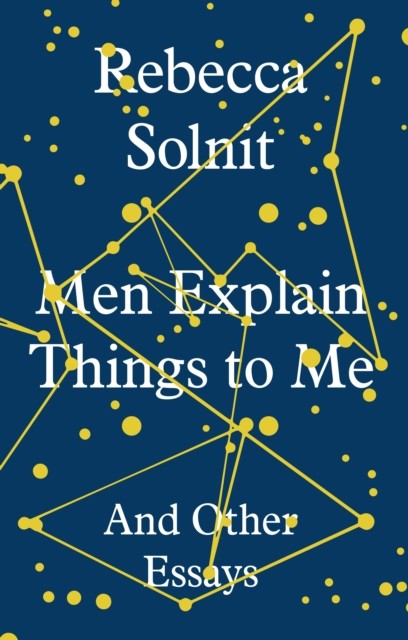
Rebecca Solnit is an American writer, essayist, and activist whose work spans feminism, politics, environment, art, and cultural history. She is the author of seventeen books, among them River of Shadows (2004), A Paradise Built in Hell (2009), The Faraway Nearby (2013), and Men Explain Things to Me (2014).
Her writing combines historical reflection with political insight, and she is often described as one of the most distinctive essayists of her generation. River of Shadows won the 2004 National Book Critics Circle Award in Criticism, while Call Them by Their True Names received the 2018 Kirkus Prize for Nonfiction.
Rebecca Solnit was born in Bridgeport, Connecticut, in 1961 and raised in Novato, California. She has spoken openly about her difficult childhood, recalling that she “grew up in a really violent house where everything feminine and female and my gender was hated.” She left conventional schooling early, completing her education through alternative programmes and later earning a degree from San Francisco State University.
In 1984, she completed a master’s degree in journalism at the University of California, Berkeley, and began her career as an independent writer.
Her early books, such as Savage Dreams (1994) and A Book of Migrations (1997), explored themes of landscape, identity, and political resistance. Over time, her essays expanded into studies of walking, technology, and social change.
She has written for The Guardian, Harper’s Magazine, and TomDispatch, and was the first woman to hold a regular column in Harper’s long-running “Easy Chair.” Her prose style is precise yet lyrical, using personal reflection to illuminate historical movements and collective experience.
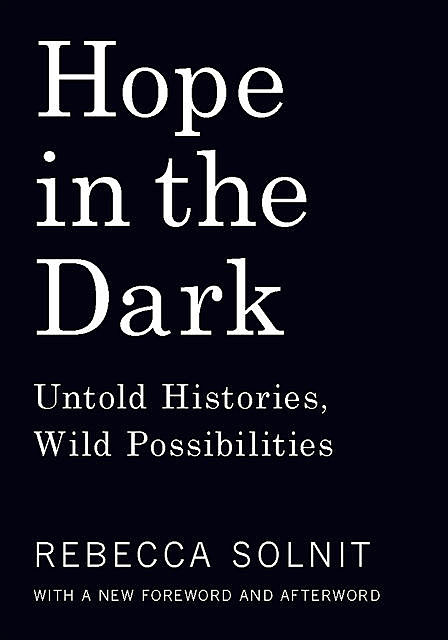
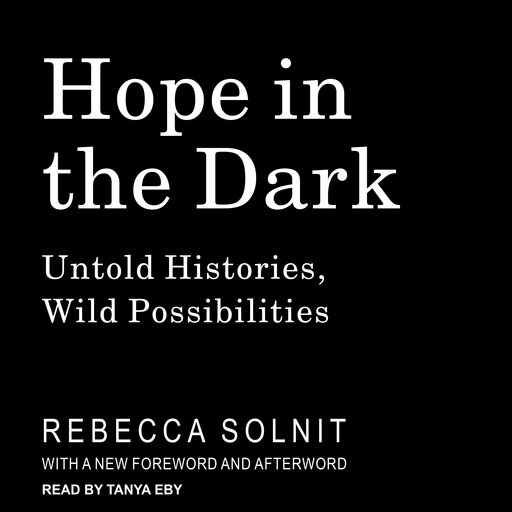
Among her most widely read works is Hope in the Dark (2004), written during a period of political uncertainty and war. The book argues that hope is not a passive emotion but a form of action — “a commitment to act in a world whose future remains uncertain.” Drawing on examples from social movements, environmental activism, and cultural transformation, Solnit contends that the consequences of human action are often invisible or delayed.
She rejects despair as a form of misplaced certainty about what the future will bring. Critics described Hope in the Dark as “an elegant reminder that activist victories are easily forgotten” (The New Yorker) and “one of the best books of the 21st century” (The Guardian). The revised edition, published by Haymarket Books, includes a new introduction and afterword reflecting on the politics of climate and resilience in the twenty-first century.
Rebecca Solnit continues to publish essays and edited volumes, including Not Too Late: Changing the Climate Story from Despair to Possibility (2023) and No Straight Road Takes You There (2025).
Her writing combines historical reflection with political insight, and she is often described as one of the most distinctive essayists of her generation. River of Shadows won the 2004 National Book Critics Circle Award in Criticism, while Call Them by Their True Names received the 2018 Kirkus Prize for Nonfiction.
Rebecca Solnit was born in Bridgeport, Connecticut, in 1961 and raised in Novato, California. She has spoken openly about her difficult childhood, recalling that she “grew up in a really violent house where everything feminine and female and my gender was hated.” She left conventional schooling early, completing her education through alternative programmes and later earning a degree from San Francisco State University.
In 1984, she completed a master’s degree in journalism at the University of California, Berkeley, and began her career as an independent writer.
Her early books, such as Savage Dreams (1994) and A Book of Migrations (1997), explored themes of landscape, identity, and political resistance. Over time, her essays expanded into studies of walking, technology, and social change.
She has written for The Guardian, Harper’s Magazine, and TomDispatch, and was the first woman to hold a regular column in Harper’s long-running “Easy Chair.” Her prose style is precise yet lyrical, using personal reflection to illuminate historical movements and collective experience.
Among her most widely read works is Hope in the Dark (2004), written during a period of political uncertainty and war. The book argues that hope is not a passive emotion but a form of action — “a commitment to act in a world whose future remains uncertain.” Drawing on examples from social movements, environmental activism, and cultural transformation, Solnit contends that the consequences of human action are often invisible or delayed.
She rejects despair as a form of misplaced certainty about what the future will bring. Critics described Hope in the Dark as “an elegant reminder that activist victories are easily forgotten” (The New Yorker) and “one of the best books of the 21st century” (The Guardian). The revised edition, published by Haymarket Books, includes a new introduction and afterword reflecting on the politics of climate and resilience in the twenty-first century.
Rebecca Solnit continues to publish essays and edited volumes, including Not Too Late: Changing the Climate Story from Despair to Possibility (2023) and No Straight Road Takes You There (2025).
years of life: 24 June 1961 – present
Books
- unavailable
- unavailable
- unavailable
Audiobooks

Voice
- unavailable
Series
- 2.4K
- 13
WNYC Studios,Trevor Aaronson,Micah Loewinger,Tricia Romano,Sam Eifling,Michael J. Mooney,Tom Wolfe,Brooke Gladstone,River Donaghey,Matthew Taylor,Zack Beauchamp,Lynsey Addario,Alicia Montgomery,Dahlia Lithwick,Kelly McBride,Jing Tsu,Curtis Sittenfeld,Carlos Lozada,Vinson Cunningham,Paul Auster,Danielle Brown,Rick Perlstein,Andrew Perez,Oren Persico,Gordon Hanson,leon neyfakh,Mary Harris,Ken Bensinger,Paris Marx,sam harnett,Julia Angwin,jeanna smialek,Matthew Goldstein,Sarah Ellison,Matt Gertz,louie nathan,clay shirkey,brooke_gladstone,David Remnick,Emily Nussbaum,Jonathan Freedland,Rachel Abrams,Nick Wallis,Rebecca Thomson,Lee Castleton,Cory Doctorow,David Folkenflik,Shane Gero,Mark Joseph Stern,allison orr larsen,judd legum,Corey Robin,Joseph Thompson,Jack Hamilton,Zach Woods,Brandon Gardner,Iyad El-Baghdadi,Jonathan Blitzer,Jake Bittle,Ian Ward,Simon van Zuylen-Wood,Andrew Prokop,John Herrman,Rick Hasen,Ezra Klein,Kat Abughazaleh,Jamilah King,peregrine andrews,dennis baxter,Charles Mann,Kathryn Hughes,Betsy Hartmann,rachel cohen,emily merchant,Charlie Warzel,Taylor Lorenz,nathan grayson,makena kelly,Dan Taberski,Kate Knibbs,noel king,anat shenker-osorio,molly rosen,Drezner Daniel,Will Sommer,dan froomkin,Samantha Cole,Matt Bai,Perry Bacon Jr.,David Lurie,Courtney Kennedy,Mark Clague,Joshua Kaplan,Lilliana Mason,Macollvie Neel,Matthew Dallek,Ari Berman,Sam Gringlas,Benjamin Mullin,edie falco,john turturro,tony shalhoub,Kelly Jensen,Justin Richardson,Peter Parnell,Raviv Drucker,Nada Homsi,will oremus,Mike Schneider,josh levin,Jim Mills,Anne McGahn,Jenny Backus,Gabriel Sherman,Steven Schuster,Annie Massa,Kenneth Vogel,Helen Santoro,Katherine Mason,Jason Stanley,Tananarive Due,Nina Nesseth,Robin R. Means Coleman,Rusty Cundieff,Betty Gabriel,Waleed Shahid,ira chinoy,brandy zadrozny,Justin Peters,M. Gessen,Anna Merlan,Ben Collins,Bill Adair,Matt Pearce,Richard Reeves,Douglas Rushkoff,Hank Green,Renée DiResta,Mark Lloyd,John Fea,Nicole Hemmer,Terry Heaton,Anne Nelson,Brian Rosenwald,Katie Thornton,Joseph Torres,Elaina Plott Calabro,Drew Harwell,Ilya Marritz,ian beacock,Nathaniel Rich,Mark Phillips,Ann Powers,Latif Nasser,Daniel Immerwahr,Dan Barry,Laura Lee,Lindsey Smith,Mike Gonzalez,Tom Michael,Karen Everhart,Ed Markey,Sage Smiley,Scott Franz,Matt Katz,olivia waxman,Rebecca Solnit,David Cole,ryan broderick,elyse graham,Chris Lehmann,dara lind,oliver darcy,ed zitron,Ezra Levin,Ryan J. Reilly,Representative Don Beyer,Vittoria Elliott,Anna Sale,tasha adams,dara kerr,molly white,Becca Lewis,Yaroslav Trofimov,Beverly Gage,Mark Blyth,gordon handson,helen botemiller evich,milton kent,liz bowie,David Enrich,Derek Thompson,brian lehrer,Dorian Lynskey,Alsu Kurmasheva,Bay Fang,william ruckelshaus,Jacob Silverman,Jennifer Berkshire,Brian Moritz,rebecca clark callender,chris murphy,Mike Masnick,Jay Graber,Clive Thompson,Brian Cohen,David Pakman,Kayla Gogarty,Bryan Stevenson,Michael Koncewicz,Max Tani,Jason Leopold,McKay Coppins,Jason Koebler,Chris Geidner,Carolyn Holmes,alan weiner,Anna Gomez,pbs,Maria Stephan,Andrew Marantz,Marton Gulyas,Nancy Solomon,Elizabeth Goitein,Dion Nissenbaum,Gregorio Olivares Gutierrez,Georgia Dillane,Mike Hiestand,Paul Offit,Amanda Hess,Jessa Crispin,Dan Friedman,Tim Naftali,Katie Mangan,Elizabeth Lopatto,Noah Lanard,Diana Buttu,Adel Al Salman,nyc now,christopher werth,david brand,Mehdi Hasan,Amy O'Hara,Andreas Georgiou,Angelo Carusone,Stassia Underwood,Radio Diaries,Mycah Hazel,janae pierre,jon campbell,Jamison Foser,Deborah Amos,Peter Shamshiri,Amanda Jones,shirley wershba,joe wershba,John Tuthill,Josh Keating,bobi wine,moses bwayo,jamelle bouie,John Lennon,Greg Sargent,Pema Levy,Jake Lahut,Mark Bray,Joseph Cox,lafontaine e. oliver,Andy Kroll,Ben Lorber,G Elliott Morris,adam bonica,Matt Bennett,G. Elliot Morris,Analise Ortiz,Jesse Thorn,Dan Lamothe,Cam Higby,Laura Poitras
On the Media

Quotes

Men explain things to me, and other women, whether or not they know what they’re talking about. Some men.
- Like
- Comment
- ShareFacebookTwitterCopy link
- Report this
It’s the presumption that makes it hard, at times, for any woman in any field; that keeps women from speaking up and from being heard when they dare; that crushes young women into silence by indicating, the way harassment on the street does, that this is not their world. It trains us in self-doubt and self-limitation just as it exercises men’s unsupported overconfidence.
- Like
- Comment
- ShareFacebookTwitterCopy link
- Report this
I’ve learned that a certain amount of self-doubt is a good tool for correcting, understanding, listening, and progressing—though too much is paralyzing and total self-confidence produces arrogant idiots.
- Like
- Comment
- ShareFacebookTwitterCopy link
- Report this
fb2epub
Drag & drop your files
(not more than 5 at once)