
Books
Read in our apps:
iOS
·Android
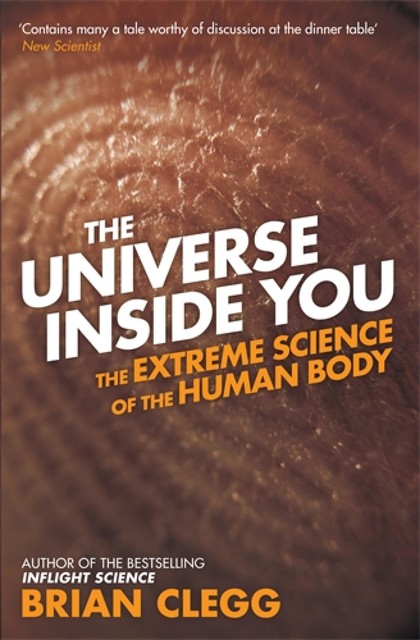
The Universe Inside You
294 printed pages
- Copyright owner
- Bookwire
- Original publication
- 2012
- Publication year
- 2012
- Publisher
- Icon Books


Quotes
- dvfgfmv9jmhas quoted5 months ago
 more to the chemist’s lab than the beauty salon.
In a typical permanent dyeing process, a substance like ammonia is used to open up the hair shaft to gain access to the cortex. Then a bleach, which is essentially a mechanism for adding oxygen, is used to take out the natural colour. Any new colouration is then added to bond onto the exposed cortex. Temporary dyes never get past the cuticle; they sit on the outside of the hair and so are easily washed off.
Worrying about hair loss
Almost every human being has hairs, but compared with most mammals we are very scantily provided. Not strictly in number – we have roughly the same number of hairs as an equivalent-sized chimpanzee – but the vast majority of these hairs are so small as to be practically useless.
Next time you are cold or get a sudden sense of fear, take a look at the skin on your arms. You should be able to see goose - dvfgfmv9jmhas quoted5 months agoisn’t particularly obvious when you hold a single strand in your hand and look at it with the naked eye, but under a microscope it becomes clear that there is more going on than just a simple filament of uniform material. In effect your hairs have three layers: an inner one that is mostly empty, a middle one (the cortex) that has a complex structure that holds the pigments and can take in water to swell up, and an outer layer called the cuticle which looks scaly under considerable magnification, and which has a water-resistant skin.
On the end of the hair, where you have pulled it out of your scalp, there may be parts of the follicle, the section of the hair usually buried under your skin. The follicle is responsible for producing the rest of the structure and is the only part of the hair that is alive.
Dyeing to be attr - dvfgfmv9jmhas quoted5 months agoOne, pheomelanin, produces red colours. Blonde and brown hair colourings are due to the presence of more or less of the other variant of the pigment, eumelanin. This is the original form of hair pigment – red hair is the result of a mutation at some point in the history of human development.
As we become older, the amount of pigment in our hair decreases, eventually disappearing altogether. Grey and white hairs don’t have any melanin-based pigment inside. In effect they are colourless, but the shape of the hair and its inner structure has an effect on the way that the light passes through it, producing grey and white tones.

fb2epub
Drag & drop your files
(not more than 5 at once)